
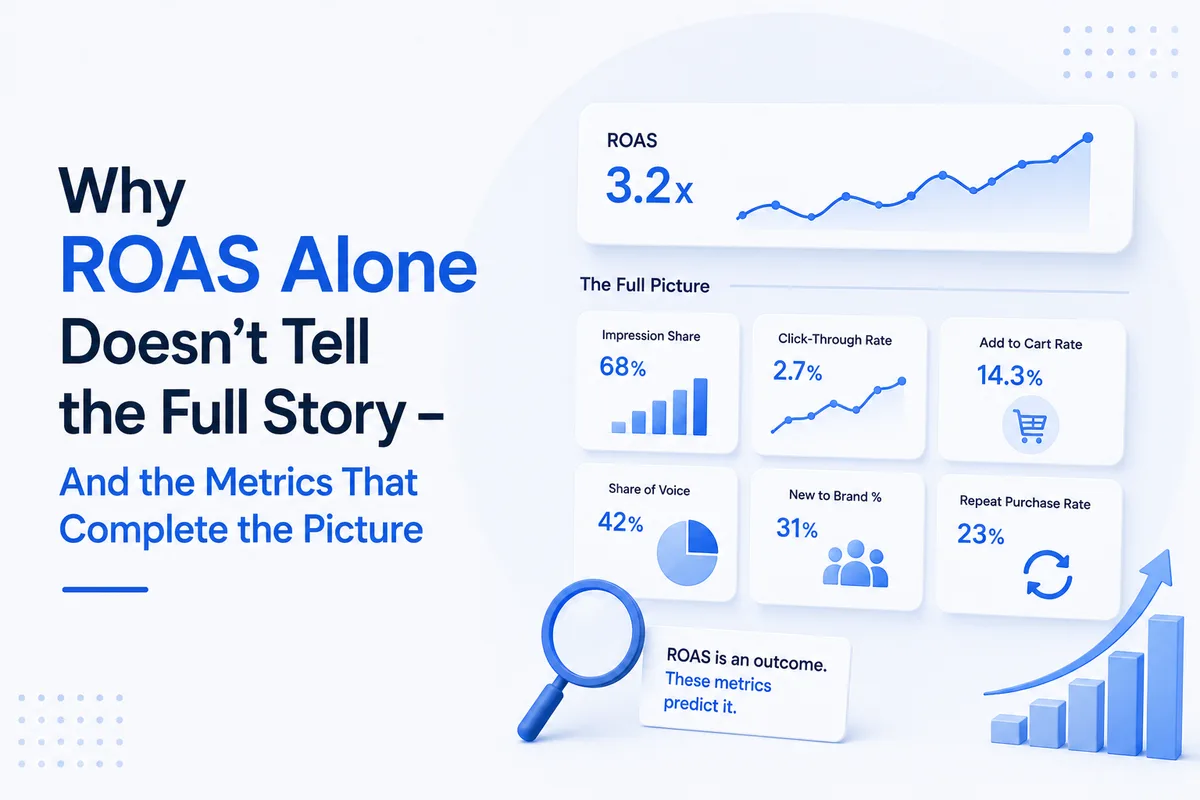
Return on Ad Spend (ROAS) serves as a standard performance metric, yet it provides an incomplete perspective for quick commerce scaling. While ROAS measures efficiency, it obscures missed opportunities and visibility gaps that constrain growth for D2C brands on platforms like Blinkit or Zepto.
ROAS is inherently backward-looking. It measures efficiency — not opportunity — and fails to reveal where expansion potential exists.
Building Beyond ROAS
Five diagnostic metrics complete the picture:
1. Impression Share per SKU × Daypart
Identifies visibility gaps across time periods. A strong ROAS might mask that 80% of impressions concentrate in morning hours while evening demand remains underexposed.
2. Click-Through Rate (CTR)
Signals relevance and creative resonance. Low CTR with high ROAS indicates narrow conversion among visible audiences while most shoppers bypass ads.
3. Add-to-Cart Rate (ATC)
Reveals pre-purchase interest. High ATC with low conversions typically indicates checkout friction — hidden costs inflating the final price substantially. A ₹105 protein bar becomes ₹142 after handling, delivery, and free-shipping thresholds, creating conversion fatigue in quick commerce’s 90-second purchase windows.
4. ATC-to-Purchase Conversion Rate
Isolates final-stage leakage. Every cart abandonment flags platform friction points like payment failures or fulfillment zone limitations.
5. Category Share of Voice (SOV)
Measures presence in relevant impressions. Strong ROAS combined with low SOV suggests efficiency in visible moments while missing broader market exposure.
The Growth Framework
Smart teams use ROAS as an output measurement while leveraging these diagnostic inputs for deeper understanding — treating it as one signal among five, not the whole scoreboard.