
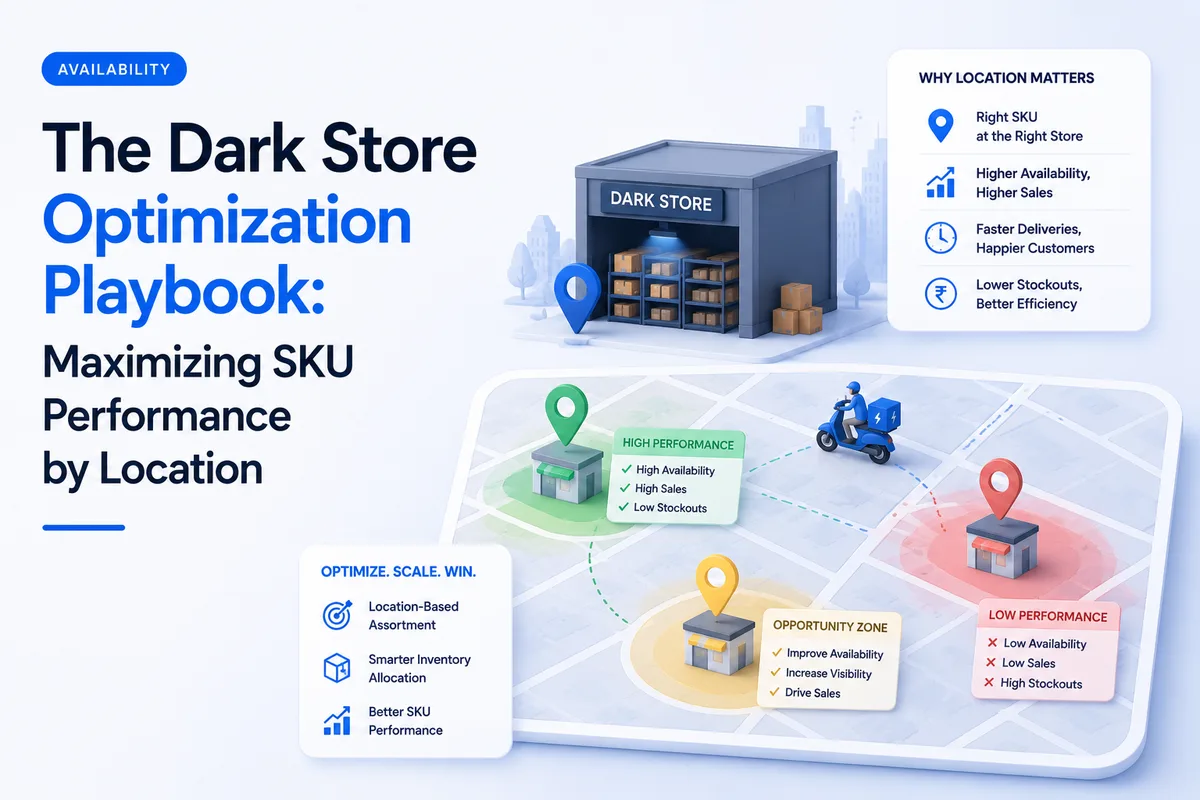
In quick commerce, product success depends on hyperlocal performance across hundreds of dark stores rather than brand strength alone. Traditional retail relies on broad market assumptions, but Q-commerce requires precision at the pin-code level.
The Hyperlocal Reality Check
Quick commerce platforms operate distinctly different inventory models than traditional e-commerce. Each dark store functions independently with unique demand patterns, competitive landscapes, and consumer behaviors. A SKU performing well in one location may be invisible in another due to localized algorithmic dynamics.
Blinkit operates over 1,200+ dark stores across India, with each serving a 2-3 km radius featuring distinct demographic profiles and purchase patterns. Brand visibility in each micro-market depends on location-specific factors rarely surfaced in platform dashboards.
The Three Pillars of Dark Store Optimization
1. Weighted Availability Strategy
Brands must weight availability by store performance and local demand intensity rather than focusing on overall platform availability. The 80/20 rule applies: the top 20% of dark stores drive 80% of volume and deserve premium inventory allocation, faster restocking, and dedicated account management.
Recommended tiered strategy:
- Tier 1 stores (top 20% by volume): 7-day inventory buffers
- Tier 2 stores (next 30%): 5-day buffers
- Remaining stores: 3-day cycles
2. Micro-Market Competitive Intelligence
Each dark store operates within a unique competitive ecosystem. For top 50 stores, identify the three competing SKUs in your category and analyze their pricing strategies, promotional frequencies, and shelf positioning patterns.
3. Algorithmic Shelf Engineering
Quick commerce platforms use sophisticated algorithms considering location-specific factors including historical performance, inventory levels, customer preferences, and competitive dynamics.
The velocity feedback loop means platforms prioritize SKUs with strong local performance metrics, creating compounding visibility advantages. Strategic launch sequencing — beginning with 10-15 high-potential stores before expanding to similar demographic clusters — builds algorithmic credibility before scaling.
Implementation Roadmap
Week 1-2: Data Foundation
- Extract location-wise performance data from platform dashboards
- Identify top 20% performing dark stores by volume and conversion
- Map competitive landscape for each priority location
Week 3-4: Strategy Development
- Implement weighted inventory allocation
- Develop location-specific pricing strategies
- Create micro-market competitive response protocols
Week 5-8: Execution and Optimization
- Launch phased expansion strategy
- Monitor location-specific performance metrics
- Iterate based on algorithmic response patterns
The Measurement Framework
Success requires moving beyond aggregate metrics to location-specific KPIs:
- Store-level Market Share: Category share within each dark store
- Velocity Index: Sales per day per store compared to category average
- Algorithmic Visibility: Average ranking across key search words by location
Brands mastering dark store optimization create sustainable competitive advantages by building location-specific moats difficult to replicate. In quick commerce, geography becomes strategy rather than destiny.